A year after the deadly terror attack in Pahalgam, India remembers the victims and reaffirms its commitment to fighting terrorism. Families of the deceased mourn their loss, while political leaders reiterate the nation's resolve to stand united against terror.

West Bengal Governor RN Ravi has called for collective efforts to restore the state's past glory, highlighting concerns over economic and educational indicators. His remarks coincided with Chief Minister Mamata Banerjee criticising him for allegedly 'abusing' her instead of extending New Year greetings.

The Trinamool Congress (TMC) has launched a strong rebuttal against Union Home Minister Amit Shah's 'chargesheet' on the West Bengal government, accusing the BJP of attempting to polarise the state ahead of elections and failing to address critical issues such as violence in Manipur and women's safety in BJP-ruled states.
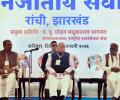
RSS chief Mohan Bhagwat stated that the Sangh's objective is to unite society, not to seek power or become a pressure group. He emphasized that the RSS is not against anyone and aims to support positive efforts in the country.

Aditya Puri is one of the cleanest examples we have, in Indian corporate history, of a leader who understood early that the measure of his work was not what happened while he was in the chair. It was what would keep happening when he was no longer there, says Suresh M K.

'We have lost 70-80 per cent of our business from foreign guests.'

The Congress party has called on the BJP-led government to adopt a unified national approach to restore India's role as a voice for peace, criticising the government's foreign policy and its impact on India's global standing.
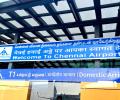
It is said that in Chennai, fans do not watch cricket -- they analyse and debate it and even outthink the experts. Cricket here is savoured like their favourite dish -- a hot bowl of rasam.
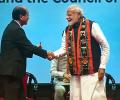
Nagaland Chief Minister Neiphiu Rio has called for strengthening Naga unity across political, cultural and social spheres, emphasising the importance of preserving collective identity.

'It is going to be a negative vote against the government rather than a positive vote for the UDF.'

As Iran heads into crucial peace talks with the United States of America, here are the six men who decide the Islamic Republic's course.

Prime Minister Narendra Modi has called on Indian citizens to unite and overcome the challenges posed by the ongoing conflict in West Asia, cautioning against politicisation and rumour-mongering.

Batters launched balls so high into the sky that they looked like rockets taking off from the centre square.

Karex, the Malaysian company that makes roughly one in five of the world's condoms -- about five billion a year, supplying Durex and Trojan among others -- announced this week that it is raising prices by up to 30 percent. The reason is the Strait of Hormuz.

Defence Minister Rajnath Singh assures India's energy security amidst West Asia tensions, highlighting naval protection of tankers and readiness to counter cross-border terrorism.
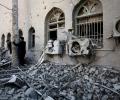
The logic of war plus the gathering storms in US politics as the midterms loom large leave him with no real alternative but to negotiate, points out Ambassador M K Bhadrakumar.

Despite a government ban, Karnataka State Open University (KSOU) in Mysuru proceeded with a lecture series on RSS ideologue Deendayal Upadhyay, featuring virtual and physical attendance by high-profile figures, sparking political controversy and raising questions about university autonomy and ideological influence.

'Many have contributed in terms of gold and silver. Ladies in big numbers have contributed their home belongings and gold.' 'Some have donated their cars too.'

Former Maldives President Mohamed Nasheed advocates for building democratic institutions over military intervention in resolving international conflicts, particularly in the context of the escalating West Asia crisis. He also discusses the impact of the conflict on the Maldives' tourism-dependent economy and calls for a stronger, more understanding India in the Indian Ocean Region.

'India's ties with Israel have to do with defence and general technology.' 'The war changes nothing in what India and Israel hope to get from the relationship.' 'It's not as though India will get significantly more benefits from Iran if India abandons Israel at this time.'

'In such a scenario, Iran could proclaim itself victor, rebuild, re-enforce its diminished regional proxies to further destabilise neighbouring nations and take control of the Persian Gulf and Strait of Hormuz.'

Although extensive air attacks have been carried out to destroy most of Iran's defence capabilities, the latter's resilience and sustenance during the war clearly indicate that the US landing force would encounter severe resistance in the operation, explains Commodore Venugopal Vengalil (retd).

The Trinamool Congress (TMC) has released its manifesto for the West Bengal elections, focusing on welfare politics and women's empowerment with pledges to expand existing schemes, improve healthcare, and develop infrastructure.

Save yourself a seat on the couch to binge watch these many OTT offerings of the week.

Eid al-Fitr was celebrated across India with prayers for peace and brotherhood, alongside protests condemning US-Israel actions in West Asia.
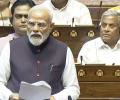
Prime Minister Narendra Modi addresses the Rajya Sabha, detailing India's strategies to navigate the global energy crisis sparked by the West Asia conflict, including securing diverse energy sources and expanding strategic oil reserves.

A senior US official has emphasised India's crucial role in maintaining peace and stability in the Indo-Pacific region and ensuring a balanced power dynamic in Asia, advocating for stronger defence ties between the two nations.

It may now be time to question the price India is paying for Israel's disregard of the serious undermining of India's energy security, asserts former foreign secretary Shyam Saran.

Egypt, Pakistan, Saudi Arabia and Turkey met in Islamabad in what analysts say is the formal opening of a new diplomatic formation that could reshape the post-war regional order. Their immediate goal is a ceasefire; their larger ambition is to ensure that neither Iran nor Israel emerges from this war in a dominant position. Pakistan's foreign minister then flew directly to Beijing and mooted a Chinese role as guarantor of any eventual agreement. Prem Panicker continues his must read daily blog on the Gulf War.

Ahida Sarmai, a special child with Down's Syndrome, makes her own space among Dhurandhar's biggest stars.

Indore in Madhya Pradesh, Puducherry and Prakasam in Andhra Pradesh also witnessed a tense atmosphere amid confrontation between the party workers.
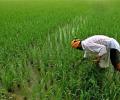
India is already a heavyweight in global farm trade in pockets such as rice exports, but experts are urging a pivot from a subsidy- and procurement-driven mindset to a productivity and nutrition strategy that still shields farmers from volatility.

The question is no longer whether the war will expand. It has. The next few days will tell us whether the war stabilises around Hormuz or whether the Strait itself becomes the trigger for a far larger rupture. What to watch for over the next 48 hours is simple: Any move by the US toward direct naval control of the Strait; any credible Iranian attempt to disrupt or mine shipping lanes and, critically, whether energy infrastructure in the Gulf continues to be targeted.If those lines are crossed in tandem, the war will no longer be containable within the region.

Alliances fight wars effectively only when they share an endgame. If Israel acted without US knowledge, then the military alliance is operating without real coordination at the level of strategic targeting. Neither picture is reassuring in a war that is no longer regional in its consequences. Prem Panicker continues his must read daily blog on the Gulf War.

The United States, which entered this war in expectation of a short, sharp win along the Venezuela model, is now preparing for deeper involvement in a conflict it does not fully control, without the allies it typically relies on, against an adversary that is not behaving as expected, in a global environment that is already absorbing economic shock. Prem Panicker continues his must read daily blog on the Gulf War.

Israel and the United States had a plan. Iran punched back. And now the Gulf is reeling, the world is beginning to feel the pain and, as on date, no one in Washington or Tel Aviv appears willing to admit that the punch has landed, notes Prem Panicker, continuing his must-read blog on the war in the Middle East.
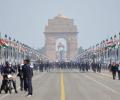
Jammu and Kashmir Chief Minister Omar Abdullah has urged the central government to approve West Bengal's request to rename the state, following the approval of a similar proposal for Kerala.

Tunisian filmmaker Kaouther Ben Hania discusses her docudrama 'The Voice of Hind Rajab,' which focuses on the tragic story of a six-year-old Palestinian girl killed during the Israel-Gaza conflict, and her motivations for making the film.

Bangladesh is set to hold parliamentary elections with unprecedented security measures in place, following a period of interim governance and political changes.

For weeks, the war skirted the edge of catastrophe without tipping over. Missiles flew, there was much destruction, commanders were assassinated, cities across the Gulf and even in Israel struggled to absorb the shock. But one line held: Energy infrastructure, the arteries of the global economy, remained largely untouched. That is no longer true. Prem Panicker continues his must read daily blog on the Gulf War.
 © 2026 Rediff.com - Advertise with us - Disclaimer - Privacy Policy - Sitemap - Feedback - About us - Terms of use - Grievances